Formative Assessment
ONPAR Community NGSS Brief – Actionable Assessment for NGSS Classrooms
Why Formative Assessment?
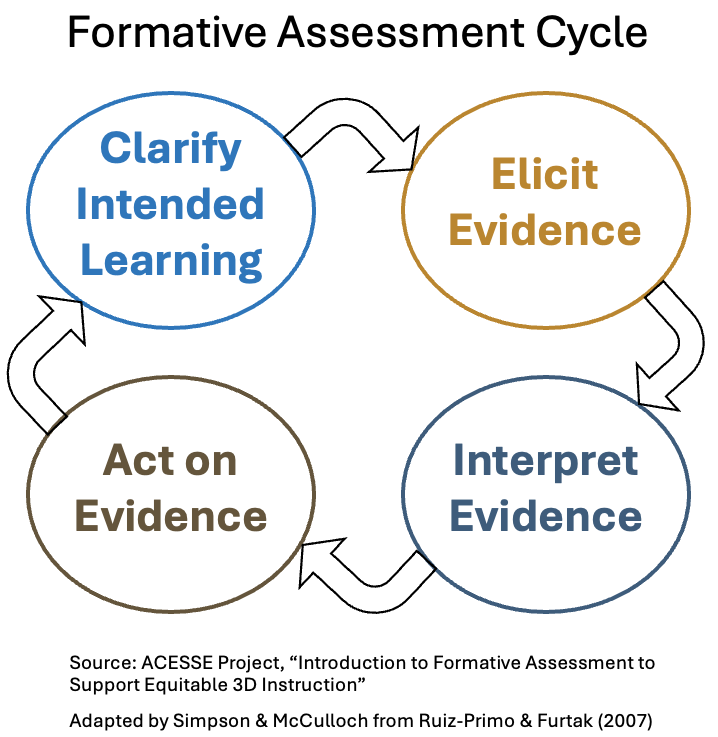
The Formative Assessment Cycle (see figure) plays a crucial role in NGSS classrooms. Unlike summative assessments that formulate “final” grades, formative assessments offer valuable insights into students’ scientific thinking as they work toward three-dimensional learning goals. These planned, often brief actions provide snapshots of student thinking. Examples of formative assessment include initial student models of phenomena, listening to small group discussions, and exit tickets. These assessments are not graded, but used to inform teaching and learning. ONPAR is a formative assessment tool to help both teachers and students better understand what students know and can do. From there, they can make more strategic decisions to guide the next steps for learning.
Challenges of Formative Assessment
When teachers have access to quality 3D formative assessments, they are better equipped to elicit and interpret the evidence from student responses. The biggest challenge is often figuring out what action to take next. Given the pressure placed on teachers to “cover the content,” it can feel like there is not enough time to stop, detour, or revisit a concept to help students who are still developing their thinking. Building a classroom culture where students can safely admit that they do not understand something and are given multiple opportunities to learn before a graded assessment also takes time and persistence.
Successful Formative Assessment
The best formative science assessments are multi-dimensional and challenge students to construct knowledge, not recall discrete facts. When students receive timely, specific feedback they develop metacognitive awareness about where they are in their understanding and can set goals to focus their learning. Students are most willing to receive feedback in an environment that values learning processes over having the “right answers.” Teachers can use formative data to make decisions about the needs of a whole class, small groups, or individuals to provide differentiated 3D instruction that moves all students’ learning forward. ONPAR extended tasks support teachers’ ability to take action on assessment results by providing detailed, easy to read classroom reports. Read on to learn more.
References
Atasoy, V., & Kaya, G. (2022). Formative assessment practices in science education: A meta-synthesis study. Studies in Educational Evaluation, 75, 101186.
Beatty, A., & Schweingruber, H. (2017). Seeing Students Learn Science: Integrating Assessment and Instruction in the Classroom. Washington, DC: The National Academies Press. https://doi.org/10.17226/23548.
Black, P., & Wiliam, D. (2009). Developing the Theory of Formative Assessment. Educational Assessment Evaluation and Accountability, 21, 5–31. https://doi.org/10.1007/s11092-008-9068-5.
Furtak, E. (2023). Formative Assessment for 3D Science Learning: Supporting Ambitious and Equitable Instruction. Teachers College Press.
STEM Teaching Tools. (2014-2024). ACESSE Resource A: Introduction to Formative Assessment to Support Equitable 3D Instruction.
Look Inside: Classroom Reports
How do I read the information in the ONPAR Classroom Report?
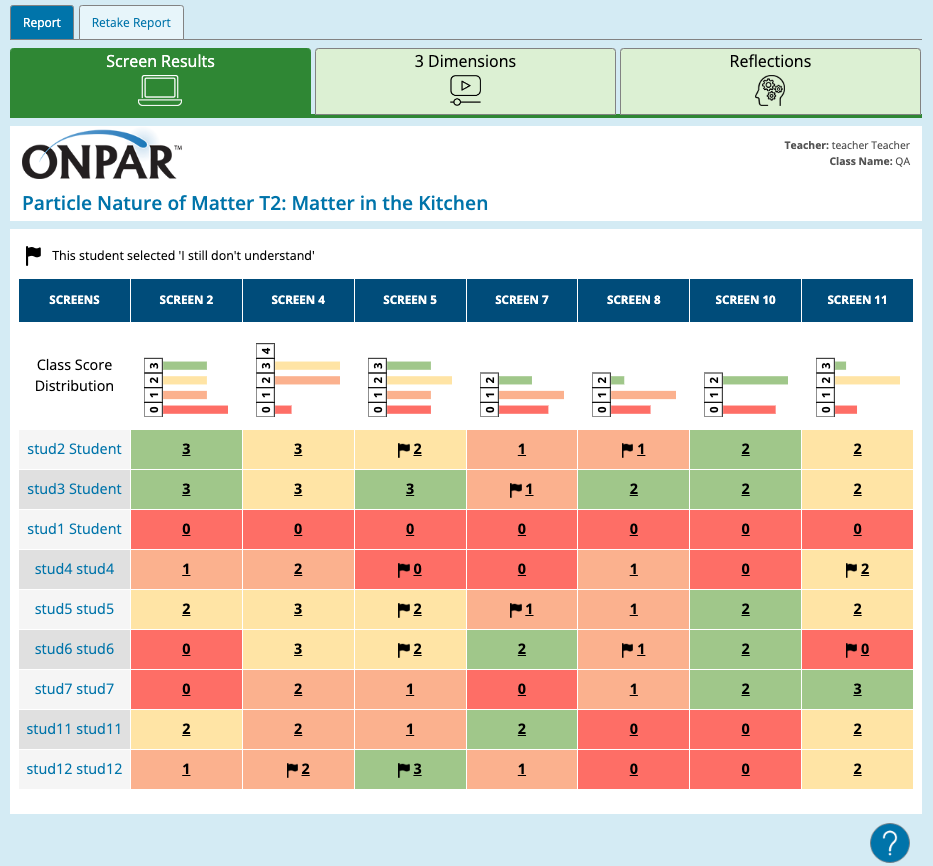
ONPAR’s Classroom Reports are designed to help you quickly interpret formative data so you can take informed action. If you’re a long-time ONPAR user, you’ll notice a more user-friendly format. The classroom report is dense with information by screen and by dimension. Watch a video tutorial for how to read them.
How can I interpret ONPAR’s formative assessment data?
As you’re reading your ONPAR Classroom Report, the type of question you might ask differs for each section.
- Screen Results (Tab 1): Which screens did most students understand? Which should I review with the whole class? Which should I review with small groups?
- Science Ideas (Tab 2): Which Big Ideas (DCIs) were the strongest for the class? Weakest? Which Big Ideas should I reteach to everyone? To a small group?
- SEPs and CCCs (Tab 2): Are students moving from “beginning” to “developing” to “advanced” on the Practices or Crosscutting Concepts? Is there an SEP or CCC with a majority of students in “advanced” (to celebrate) or “beginning” (to support)?
- Student Reflections (Tab 3): Where do my students feel confident? How can I support the goals they set? What feedback (if any) should I send?
Putting This Into Practice
How can I use discussion to take action on formative data?
After interpreting the evidence from an ONPAR (or other formative) task, your next step might be discussion-based. Here are a few options:
- Whole-class discussion: If a majority of your class needs the same action, a whole-group discussion is helpful. You might see an ONPAR screen where students underperformed or where you want to clarify science content. You can also highlight successful strategies students used on a particular question or discuss popular incorrect or incomplete answers.
- Differentiated small-group discussion: When students need different actions, small groups can be beneficial. You can use the “Discussion Questions” in ONPAR’s Teacher Guide to differentiate discussion prompts for each group. You might use a “jigsaw” strategy to have students share their ideas with the rest of the class.
- Recurring discussions: When you need to take action on a broader topic, like a Crosscutting Concept, you may need regular discussions over time. These prompts (PDF) can help you incorporate CCCs into your daily instruction. Your students might also benefit from sentence starters to build up their discourse skills. You can make these specific to each lesson or have general prompt cards available for student tables.
Updates
Updated Reports: If you don’t see the new reports yet, be patient! We’re rolling them out in stages, so half of our units will have updated reports this January. The rest will be coming over 2025.
ONPAR Portal: Also coming in January, you’ll see updates in the “Units and Tasks” section of the portal. We’re expanding the tiles to give you more detail about mini and paper tasks, as well as embedding directions videos for students at the beginning of each digital task.
ONPAR Tips: Do you want to share your experience with ONPAR? Reply to this email with a short explanation of a way you’re leveraging ONPAR in your classroom to be included in a future newsletter.
Study Recruitment: Do you think your school district would be interested in participating in our study of ONPAR efficacy? Teachers will receive PD and a stipend for their participation. We’re actively recruiting for next school year and would be happy to talk more if you’re interested! Reply to this email for more information.
Support for this project comes from the U.S. Department of Education, Education Innovation and Research (EIR) Grant Number S411C220116, Laura Wright, Principal Investigator, Linda Malkin, Co-PI.