Modeling
ONPAR Community NGSS Brief – Actionable Assessment for NGSS Classrooms
Developing and Using Models is one of eight Science and Engineering Practices (SEP) of NGSS. SEPs engage students in the particular skills and approaches used by scientists and engineers to develop explanations of phenomena and solve problems. Read on to see how ONPAR can help your students practice this important skill.
Why Modeling?
Students use models as an important tool in sensemaking. The process of modeling helps them figure out or explain why or how a phenomenon occurs. Models are built and revised as they gather more data and interpret new evidence. Because models are flexible, changing, and often interactive, they provide visual, mathematical, or physical representations that aid the ability to explain or predict outcomes.
Modeling Challenges
There are three types of problems that can arise when using modeling in the science classroom:
- Difficulty representing ideas. Students who are new to modeling often struggle to figure out how to start making their model or what to write down.
- Difficulty emphasizing key ideas. Students may give equal weight to less important information, overly complicating their models.
- Difficulty embracing varied ideas. Teachers and students often believe there is one “right answer” and only one way to create a model. They are fearful of making mistakes or having an incomplete response.
Successful Modeling
Successful implementation of modeling in NGSS classrooms is scaffolded and iterative. Developing the practice of modeling requires teachers to provide a variety of supports over time, applied in different contexts. This includes building a classroom culture where students can safely share their thinking without fear of “being wrong.” As students return to the same model multiple times to add new information or revise it, they become more aware of their own learning. This helps students articulate their deepening understanding of science concepts.
References
Chiu, MH. & Lin, JW. (2019). Modeling competence in science education. Disciplinary and Interdisciplinary Science Education Research. 1(12).
Harrison, A.G. & Treagust, D.F. (2000). A typology of school science models. International Journal of Science Education, 22(9), 1011-1026.
Park, B.Y., Rodriguez, L., & Campbell, T. (2019). Commentary: Using Models to Teach Science. The Science Teacher 87(4), 8-11.
Look Inside: Camping & Chemistry
How does modeling develop in this ONPAR task?
A video look inside the increasing abstraction of modeling questions in the Camping & Chemistry task
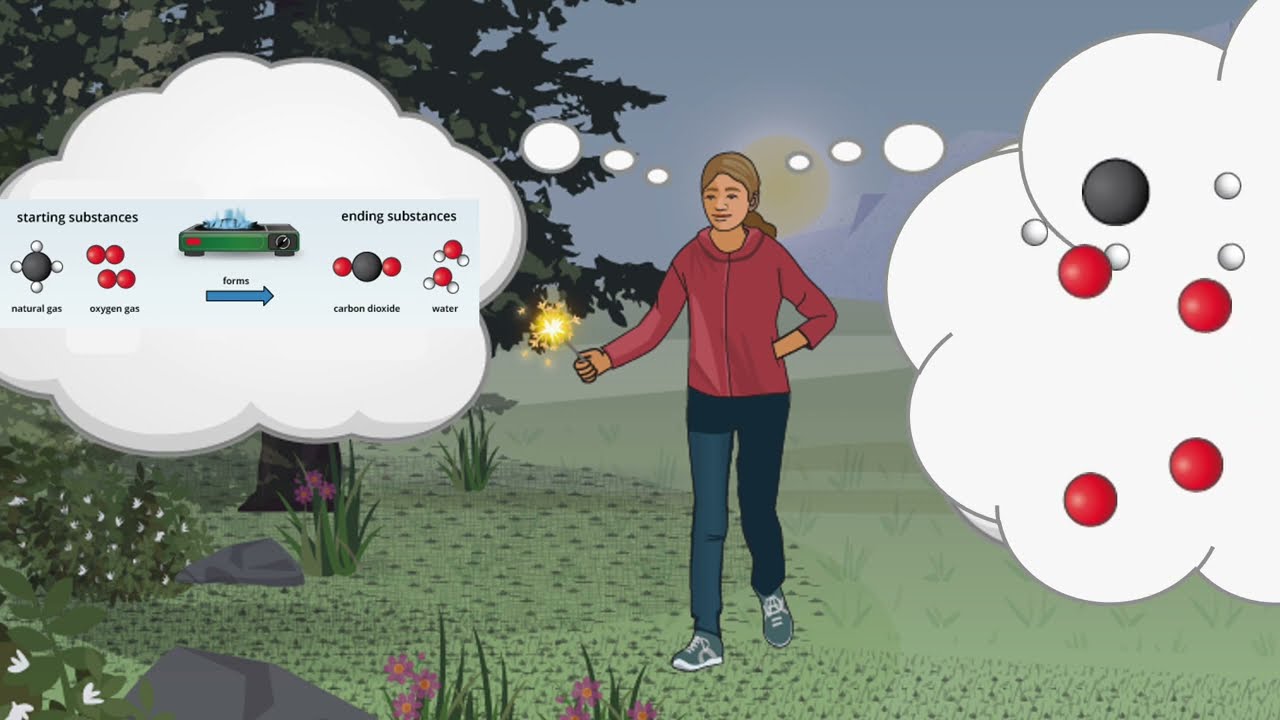
Need more practice modeling chemical reactions?
Try an ONPAR Mini Task. Both Fireworks and Sodium Sulfide offer more practice modeling a chemical reaction. Mini Tasks are short and allow for multiple attempts (up to five) with feedback before moving on to the next screen. Students might use a Mini Task in pairs before the longer task, or use as a small-group intervention afterward.
Try physical models. You can use blocks, coins, beads, or small squares of paper to represent atoms and help students see the conservation of matter literally. Students might create their own models, then do a gallery walk to highlight different styles others have created; this can reinforce the diversity of ideas or recognize the work of a student who may be reluctant to share their thinking in larger discussions. After highlighting strong elements of classmates’ models, student can revise their own.
Put This Into Practice
How can I scaffold a modeling task on my own assessments?
A valuable scaffold for many students is a word bank or checklist. Word banks can help students develop their academic language and focus on usage, rather than recall or spelling. Words like molecule, atom, or conservation can be helpful as students construct molecular models. Checklists can identify specific components, such as atoms and a chemical equation. They can also include general reminders, like asking if they labeled their molecules, checked for consistency of color, or maintained conservation of matter.
Critiquing a model can be another way to build knowledge while practicing another SEP: Engaging in Argument. Students can use rubrics to give peer feedback, then update their own models. They can also give shout-outs for elements that helped them understand something more clearly, like labels or arrows. Sentence stems can help students build their comfort critiquing and learning from each other. Colleagues in the art or language arts department might be able to share protocols they use in their classes. This process can help students see models as a work-in-progress and build comfort with incomplete answers or multiple ways of modeling.
Teacher Tip
Can I use ONPAR as a preassessment?
Marlene, an 8th grade teacher in Wisconsin, likes to start the year by assessing prior knowledge with ONPAR tasks:
As an 8th grade teacher with a scaffolded curriculum, students build on concepts from prior years. I assign ONPAR tasks from 6th and 7th grade to give me a chance to see what we understand so far, as well as so kids can see for themselves what they still need to learn or practice. Sometimes I have them work as partners, each with their own screen, and I can listen to their conversations and get a better sense of their confidence level and jot down notes for myself. Then we’ll usually go through it all together to discuss things at the same time, or I set out answer keys to self-check depending on the activity and students’ needs. I primarily use ONPAR for assessments as learning and to guide subsequent lessons and supports. The feedback from ONPAR and our discussions allows students to be active participants in the assessment of their current understanding of science content and practices.”
Do you want to share your experience with ONPAR? Reply to this email with a short explanation of a way you’re leveraging ONPAR in your classroom to be included in a future newsletter.
Updates
ONPAR Portal: This fall, we are updating some of our portal materials to help you better navigate ONPAR. Look forward to new directions videos for students at the beginning of each task, plus more detail for teachers about mini and paper tasks.
NSTA: Will you be at NSTA in New Orleans this November? Come to our session Saturday morning at 9:30 or say hello at the Activate Learning booth in the exhibit hall!
Study Recruitment: Do you think your school district would be interested in participating in our research about ONPAR efficacy? We’re actively recruiting for a one-year study of 8th grade classrooms next school year and would be happy to talk more! Reply to this email for details.
Support for this project comes from the U.S. Department of Education, Education Innovation and Research (EIR) Grant Number S411C220116, Laura Wright, Principal Investigator, Linda Malkin, Co-PI.