Crosscutting Concepts
ONPAR Community NGSS Brief – Actionable Assessment for NGSS Classrooms
Why Incorporate Crosscutting Concepts?
The NGSS Crosscutting Concepts (CCCs) bridge the scientific disciplines. These ideas are used regularly by scientists, especially when we are deciding how to engage with a phenomenon we do not yet understand. CCCs guide the way we collect evidence or put our observations together during sensemaking. For example, when we are asking “why” questions we are often describing cause and effect. Or when we want to understand the connections between components and mechanisms that drive phenomena, we build system models. CCCs apply across all disciplines, providing coherence and connecting ideas across different areas of study. Incorporating the CCCs into our teaching provides a common framework for students to navigate the science practices.
Crosscutting Concepts
- Patterns
- Cause & Effect
- Scale, Proportion & Quantity
- Systems & System Models
- Energy & Matter: Flows, Cycles, and Conservation
- Structure & Function
- Stability & Change
Challenges to Incorporating CCCs
When teaching science three-dimensionally, teachers often find CCCs the most difficult to incorporate. For many of us as adults with experience in science, these concepts are implicit. We automatically look for patterns in data or connect structure to function. However, our students are still developing these framing tools and learning to approach problems through these different lenses. When educators do not explicitly use the language of CCCs, students lack a critical scaffold that focuses their learning.
Successfully Using CCCs
Although students may come to our science classrooms without the formal language of crosscutting concepts, they come with relevant experiences. Because the CCCs connect across disciplines, leveraging students’ prior knowledge (When have you ever combined matter in the wrong proportions?) and connecting school science investigations to related phenomena (When have we changed the scale of our observations?) adds relevance to the learning. Explicitly using vocabulary associated with the CCC helps frame student thinking and supports them to develop more focused investigations (How could we measure …?), guide analysis (How do the changes in structure impact the function of …?), and write better supported explanations (Draw a picture that shows energy flowing through the system.)
References
Furtak, E. M. (2023). Formative Assessment for 3D Science Learning: Supporting Ambitious and Equitable
Instruction. Teachers College Press.
Goggins, M., Hass, A., Grapin, S., Llosa, L., & Lee, O. (2019). Integrating Crosscutting Concepts into
Science Instruction. Science and Children, September (2019), 56–61.
Nordine, J., & Lee, O. Eds. (2021). Crosscutting Concepts: Strengthening Science and Engineering Learning.
NSTA Press.
Look Inside: Traits of the Forest
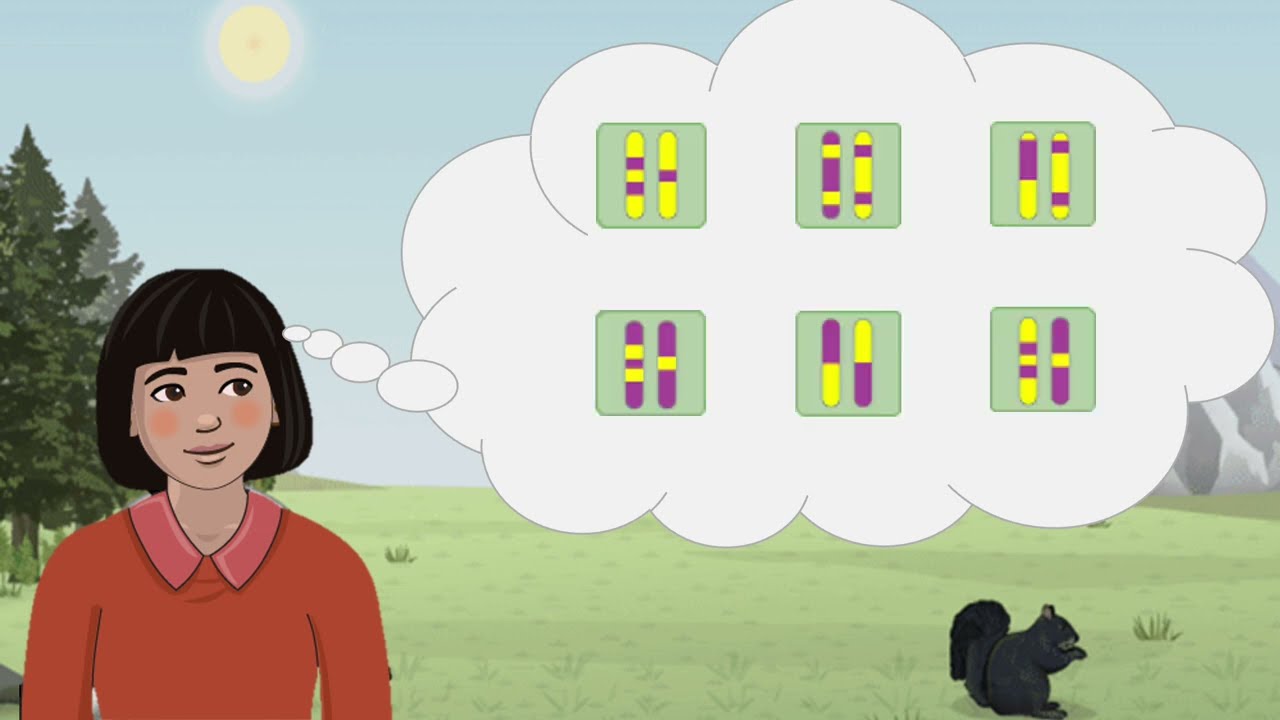
How does this task use patterns?
A video look inside the use of patterns in the “Traits in the Forest” End of Unit heredity task.
How can I give students more practice with patterns?
The CCCs offer potential for connecting with students’ lives and the knowledge they bring with them. For example, students often discuss family inheritance during a heredity unit. Explicitly identify their noticing as a pattern and ask them about other patterns they see at home. Patterns of seasonality — and how they are being altered by climate change — are another rich space to identify patterns in their community and notice population-level changes.
Prompt students to look for patterns until they start to do it naturally. While a data table might have seemingly obvious patterns, students often need prompting to look for them. Once they can see a pattern, they can also use it to make predictions. Patterns are often represented mathematically, but also occur as scientists organize and classify things by similarity and difference. Asking students to sort or compare helps build their framework for pattern identification. This STEM Teaching Tool (PDF) offers a set of prompts you can use to regularly highlight patterns (and other CCCs) in your classroom.
Put This Into Practice
How can I use writing to assess CCCs?
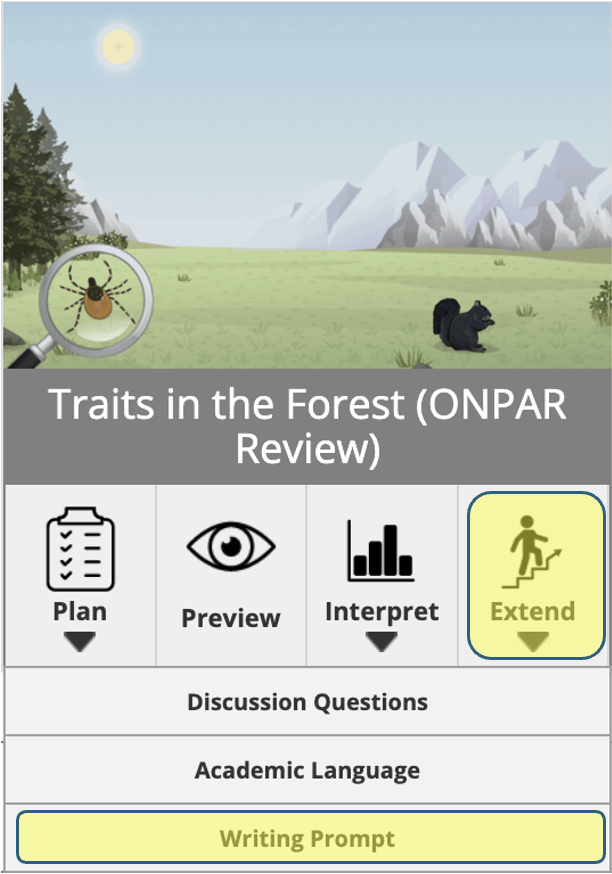
Writing is a powerful formative assessment tool, but it can be challenging to incorporate this practice into your science classroom. ONPAR offers a dozen end-of-unit writing prompts focused on the CCCs (see image below for the location in the Teacher’s Guide). Accompanying rubrics offer support for assessing both students’ writing and their depth of understanding on each of the three dimensions in the prompt.
In addition to these extended writing tasks, you might start incorporating more “quick writes” in your classroom, like a short paragraph for an exit ticket. CCC question stems (PDF) can be a helpful starting place for building your own writing prompts. Our Academic Language Packet (PDF) also suggests having students build their writing skills by jotting ideas in everyday language or annotating readings using pictures. Graphic organizers and sentence stems can be used as scaffolds, then referenced as students move on to more formal writing tasks.
Teacher Tip
How can I use CCCs to support student sensemaking?
Joanna, an instructional coach in California, discusses the power of using patterns to understand complex models. She references a model from ONPAR’s “Light Waves & Sight” paper task.
“What if I told you that you don’t have to reteach exponents or scientific notation? Students can still engage with models like this (see below) by focusing on patterns. Ask students to examine the numbers at the bottom of the model. They’ll notice that all the base numbers are the same, so we can disregard them. As for the smaller numbers (exponents), they decrease as we move from right to left. Even if a student doesn’t fully understand why a smaller exponent corresponds to a wider wave and a larger exponent to a narrower wave, recognizing this pattern can still be a valuable tool and allow the student to have access to the information without feeling like they have to understand scientific notation. It can act as a helpful guide, allowing them to make informed predictions or choices on assessments like state tests.”
Updates
Student Videos: All digital tasks now open with a short directions video for students, explaining how to interact with the task. They can review the video at any point by clicking the new video icon on the bottom right (see image).
Teacher Tip: Do you want to share your experience with ONPAR? Reply to this email with a short explanation of a way you’re leveraging ONPAR in your classroom to be included in a future newsletter.
Study Recruitment: Do you think your school district would be interested in participating in our study of ONPAR efficacy? We’re actively recruiting for next school year and would be happy to talk more if you’re interested! Reply to this email for more information.
Support for this project comes from the U.S. Department of Education, Education Innovation and Research (EIR) Grant Number S411C220116, Laura Wright, Principal Investigator, Linda Malkin, Co-PI.