Formative Feedback
ONPAR Community NGSS Brief – Actionable Assessment for NGSS Classrooms
Why provide formative feedback?
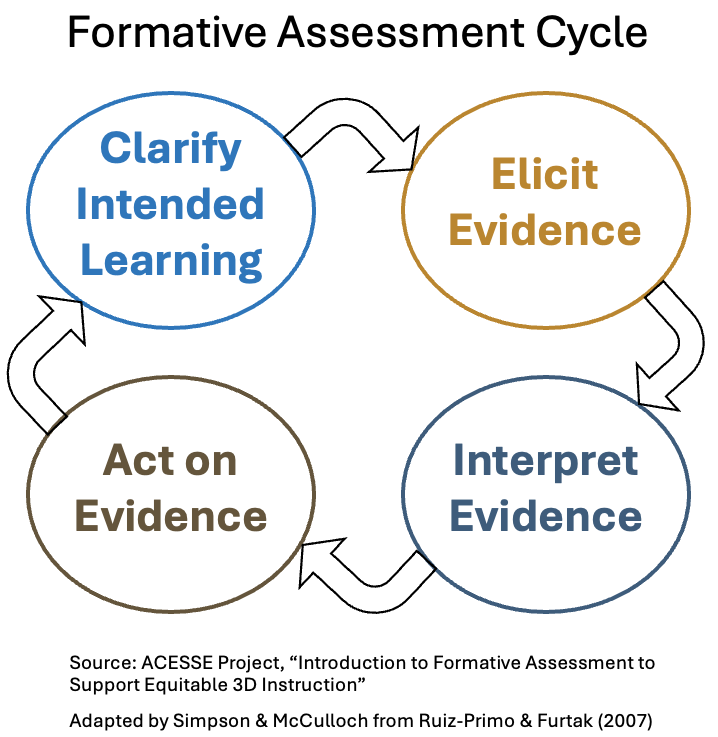
After eliciting and interpreting evidence from a formative assessment, the next step is deciding what to do based on the results. If we are formatively assessing complex, three-dimensional science ideas, our goal is to constantly push student thinking forward, regardless of where they are in their sensemaking. One way to act on evidence is to provide feedback on the assessment directly to students. Feedback takes many forms: we can tell students if they are right or wrong, paraphrase their thinking, or encourage deeper thinking.
Challenges
When we provide feedback in real time, it can be difficult to think of the right question in the moment to push on student sensemaking. The quickest and easiest type of feedback is a “yes” or “no” that does not invite deeper thinking. When we assess written work, providing every student with a concise, useful message that pushes their thinking forward can be time-consuming. Unfortunately, research also suggests that many students focus only on the grade they receive and do not read personalized feedback, making the effort appear unnecessary.
Successful feedback
If students and teachers understand formative assessment as part of an iterative process that deepens conceptual understanding over time instead of merely a graded activity, feedback becomes more relevant. Different students benefit from feedback with different intentions. When crafting responses to student work consider what a student needs: more explicit help with the task, guidance about the generalizable process they are learning, practice using rubrics to self-regulate, or help making additional connections to personal experiences and outside phenomena. When planning for a formative assessment, consider the three-dimensional learning target and prepare questions you might ask students in class or as you review written work. If you’d like suggestions for these questions, see the references below.
References
Furtak, E. M. (2023). Formative Assessment for 3D Science Learning: Supporting Ambitious and Equitable Instruction. Teachers College Press.
Penuel, W.R. and Van Horne, K (2018). Prompts for Integrating Crosscutting Concepts into Assessment and Instruction. STEM Teaching Tools.
Van Horne, K, W.R. Penuel and P. Bell (2018). Integrating Science Practices into Assessment Tasks. Stem Teaching Tools.
Youki Terada, Y, and Merrill, S. (2024). Why teachers should grade less frequently. Edutopia.
Look Inside: Student Reports
How does ONPAR offer student feedback?
After each full online task, students get immediate feedback in their report. This video shows students how to interact with the report.
How does ONPAR feedback contribute to student sensemaking?
ONPAR’s automatic reporting gives timely, low-stakes feedback. Tabs 1 and 2 give students specific, personalized, actionable information that is tied to the three-dimensional learning goals of the task. Multimodal feedback offers differentiated responses including focus questions, “Big Idea” videos, and the ability to review their answers. Tab 3 builds in space for metacognition and reflection. Students write about their strengths and set reasonable goals, giving teachers insight into student thinking beyond assessment scores.
Put This Into Practice
How can I give feedback after an ONPAR task?
Whether you gave a digital or paper task, students will benefit from some form of feedback, especially once you’ve established a classroom culture focused on growth. Sometimes, this will happen through discussion with the whole class or a small group. You might share a recurrent misunderstanding you noticed on the classroom report or while grading a paper task, then immediately reteach. Alternatively, you can use the ONPAR “guiding questions” found in the teacher guide for each task to push student thinking while providing feedback on their ideas.
On paper tasks, you will likely give individualized, written feedback. It is helpful to connect your feedback to the learning goal and be explicit about next steps. One strategy is to ask questions; this helps students with misunderstandings as well as those who have mastered the learning target. You might sort student work into a few buckets and write the same question or comment for an entire set. It can also be helpful to use a highlighter to connect a theme across multiple questions or help a student build on a successful strategy from a different part of the assessment.
Teacher Tip
How can I give good feedback on ONPAR tasks?
One of our ONPAR users offered this anonymous tip for using ONPAR rubrics that they developed during their science PLC (professional learning community).
“We use a “Looking at Student Work Protocol” where we all quickly scan the work from one class and divide it into 3 categories: high, medium, and low based on student responses. We then talk through an approach to grading based on recommendations from the ONPAR rubric. For the lactose intolerance paper task, we assigned 0.5-point increments instead of the one point increments provided.
Each student receives a copy of the ONPAR rubric where I underline the things students did correctly and circle the things students did not do correctly. Once the task is graded, students receive the task back with feedback about strengths and areas of growth. Students are able to ask questions about how their work was graded or disagree.”
Updates
Wrapping Up Year 1 Study: Thank you to all of the educators who participated in year 1 of our ONPAR efficacy research. We will be analyzing the data you provided us and sifting through your feedback and suggestions to improve our program for next year.
ONPAR Tips: Do you want to share your experience with ONPAR? Reply to this email with a short explanation of a way you’re leveraging ONPAR in your classroom to be included in a future newsletter.
Study Recruitment: Do you think your school district would be interested in participating in our study of ONPAR efficacy? We’re actively recruiting for next school year and would be happy to talk more if you’re interested! Reply to this email for more information.
Support for this project comes from the U.S. Department of Education, Education Innovation and Research (EIR) Grant Number S411C220116, Laura Wright, Principal Investigator, Linda Malkin, Co-PI.