Vocabulary in Science Class
ONPAR Community NGSS Brief – Actionable Assessment for NGSS Classrooms
Why Incorporate Vocabulary Instruction?
Vocabulary knowledge is one of the greatest predictors of students’ academic success. In science classrooms, vocabulary development is key to conceptual understanding because it is a way of knowing and representing the world. Supporting students’ vocabulary development provides them with the tools they need to express themselves as they come to understand the natural world in scientific ways.
Vocabulary Instruction Challenges
In science education the pendulum has swung between extreme views of vocabulary, from teaching lists of words out of context to suggesting that it is more useful for students to “use their own words.” This makes it hard for teachers to know when to introduce key terms and when to expect students to use them proficiently. Science terms may have multiple meanings or represent abstract concepts, and teachers might not feel they have the toolkit necessary to support students. Additionally, vocabulary instruction has to compete for time with other activities, so teachers may not feel they have enough time to dedicate to vocabulary.
Successful Vocabulary Instruction
To successfully integrate vocabulary development into science lessons, teaching a few words in context regularly will help build this important skill and enhance other class activities. Introducing key terminology when students are learning will help them build the necessary schema for new ideas. One way to do this is to have students keep vocabulary journals. This helps students track new words by writing definitions, examples, and representations (e.g., models, illustrations). In addition, students should have opportunities to use new words in context once they have been introduced. It’s important to provide ample time to use the new vocabulary through talking and writing so that students can express their understanding of the new content while they are learning and gain new confidence with the words.
References
August, D., & Shanahan, T. (Eds.). (2006). Developing literacy in second language learners: Report of the national literacy panel on language minority youth and children. Mahwah, NJ: Erlbaum.
Marzano, R., Rogers, K., & Simms, J.A. (2015). Vocabulary for the New Science Standards. Marzano Resources.
Suárez, E., Bell, P., McCulloch, A., & Starr, M. (2020, March). Why you should stop pre-teaching science vocabulary and focus on students developing conceptual meaning first. STEM Teaching Tools.
Look Inside: Dynamic Earth
How is vocabulary supported in “Dynamic Earth”?
All ONPAR tasks include a variety of scaffolds to support students as they’re building their scientific vocabulary. Watch a video to see how they are embedded in the “Dynamic Earth” task.
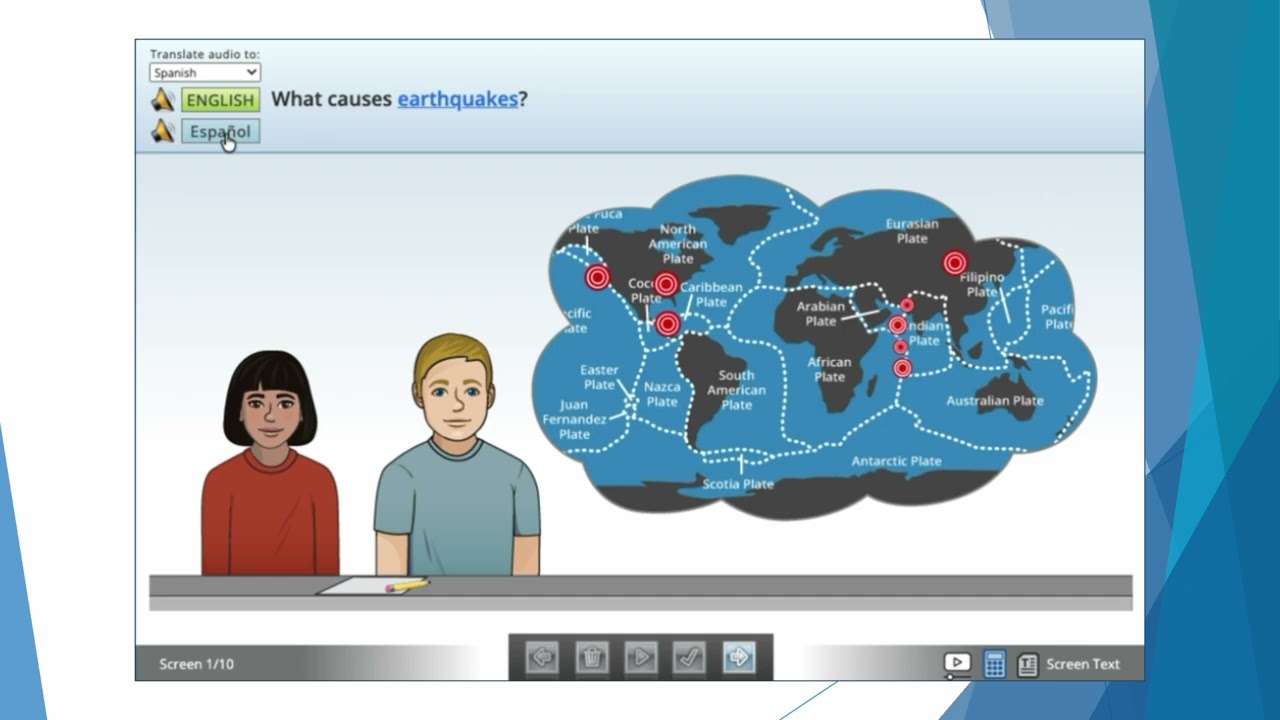
How do I know what words to teach for an ONPAR task?
In the “Background” section of the Teacher’s Guide, there is a vocabulary packet with definitions, example sentences, and cards that can be printed and displayed in the classroom. It is important that students are exposed to terminology, meanings of the terms, and how to use them in context. Lists are not intended to be used for rote memorization, but within the context of learning and practicing using science content. Some vocabulary words have concrete meanings and may be easier for students to learn, whereas others will need to be built up over time. A term such as volcano is content-specific and can be depicted. Other terms such as magnitude may have multiple meanings or nuanced meanings within different domains. Finally, a term such as convection or seismic is less concrete and may require several examples to help build students’ understanding. The vocabulary lists provided are not intended to be comprehensive of all words that students might need to learn during a unit, but provide a foundation to expand upon.
Put This Into Practice
How can I use ONPAR to build vocabulary?
Students need to learn new words and have ample time to practice them, and there are many creative ways to use ONPAR for this goal. Consider some of these strategies:
- Preview for vocabulary: Preview challenging screens by reviewing and discussing vocabulary necessary for the question. This will help activate students’ knowledge before they need to apply it.
- Explore vocabulary: Have students go through the task with their vocabulary journal or science notebook. They can use ONPAR visuals and context to help determine the meaning of a set of words.
- Driving questions: Most mini tasks open with a driving question. Use this as an exit slip after the task to reassess student understanding and vocabulary development in a short, written response.
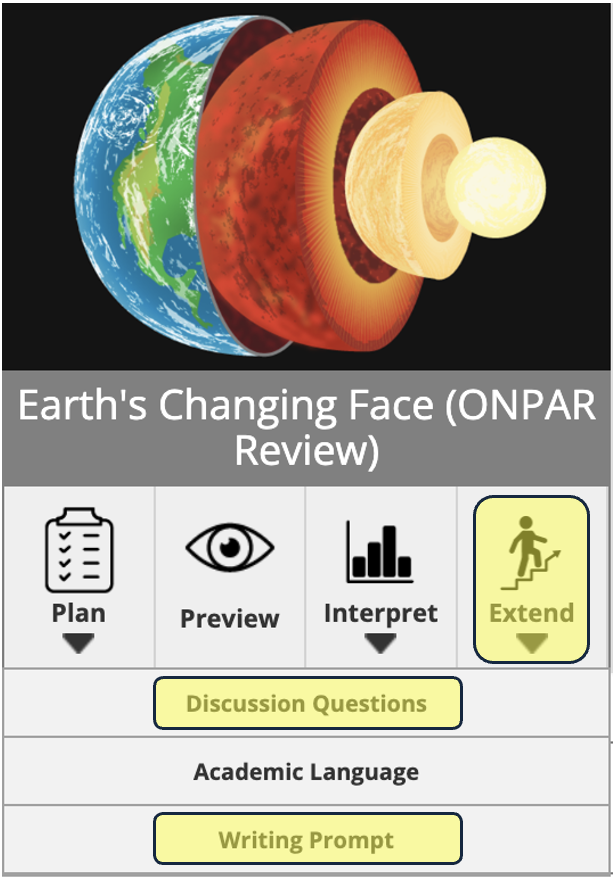
- Discussion questions: After students are introduced to new terms, they need time to practice using them in context. ONPAR provides discussion questions to help assess how students are using scientific vocabulary. Find these in the “Extend” drop-down menu in all of our full-length tasks.
- Writing prompts: Longer writing exercises are another way to assess student vocabulary use. Look in the “Extend” drop-down menu of each “ONPAR Review” (formerly “End of Unit”) task. You’ll find a question based on an ONPAR context, plus a rubric that includes three-dimensional science knowledge and vocabulary.
Updates
Using ONPAR Reports: If the student or classroom reports feel overwhelming, there are training videos for both available under the “Interpret” tab of each extended task.
Teacher Tips: Do you want to share your experience with ONPAR? Reply to this email with a short explanation of a way you’re leveraging ONPAR in your classroom to be included in a future newsletter.
Support for this project comes from the U.S. Department of Education, Education Innovation and Research (EIR) Grant Number S411C220116, Laura Wright, Principal Investigator, Linda Malkin, Co-PI.