3D Assessment
ONPAR Community NGSS Brief – Actionable Assessment for NGSS Classrooms
Why Assess the Three Dimensions?
Once we understand what it means to teach three dimensionally, the next challenge is assessing students in all three dimensions. We want to know not only if students are mastering science facts and ideas (DCIs) but also developing the skills and practices (SEPs) necessary to conduct investigations, solve problems, and argue from evidence. We want to determine students’ ability to connect and apply their knowledge in a variety of contexts across disciplines (CCCs).
3D Formative Assessment Challenges
Assessing in all three dimensions at once is a challenge. 3D assessments necessitate more complex phenomena with data and/or evidence, making it hard to conduct quick formative assessments that accurately assess where each student stands on all three dimensions. Multiple choice and fill-in-the-blank assessments are usually insufficient to tease out multidimensional understanding. Another difficulty is assessing at grade level in all three dimensions. For example, we may want to assess students’ ability to Analyze and Interpret Data, but what does that mean for a 5th grader vs an 8th grader vs a 12th grader? We are often less aware of the learning progressions of the SEPs and CCCs than we are of the DCIs.
Successful 3D Assessment
When assessing three dimensionally, it is okay to construct an item series — multiple questions about the same phenomenon — that covers all three dimensions, with some questions covering only two dimensions at a time (DCI + CCC, SEP + CCC, or DCI + SEP). Over the course of the full assessment, build toward three dimensionality. To design a 3D assessment at grade level, spend time interpreting the full text of all three dimensions you want to assess. Learning progressions can help you figure out where your students are as they move towards mastery of the next level. For example, consider how developing math skills change student capability for the Analyze and Interpret Data SEP. One middle school element states: “Construct and interpret graphical displays of data to identify linear and nonlinear relationships.” Make sure you are not only asking students to find patterns (from the 3-5 grade band), but specifically asking students to describe changes in slope or other appropriate mathematical relationships.
Resources
- CCC Progressions (PDF): Appendix G – Crosscutting Concepts
- DCI Progressions (PDF): Appendix E – Progressions Within the Next Generation Science Standards
- SEP Progressions (PDF): Appendix F – Science and Engineering Practices in the NGSS
- Penuel, W. R., Turner, M. L., Jacobs, J. K., Van Horne, K., & Sumner, T. (2019). Developing tasks to assess phenomenon‐based science learning: Challenges and lessons learned from building proximal transfer tasks. Science education, 103(6), 1367-1395.
Look Inside: Energy in Action
How are the three dimensions integrated in this task?
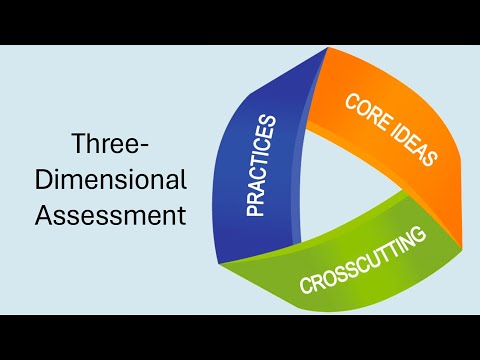
Watch a video on how the three dimensions are interconnected in “Energy in Action.”
How do I find the three dimensions for an ONPAR assessment?
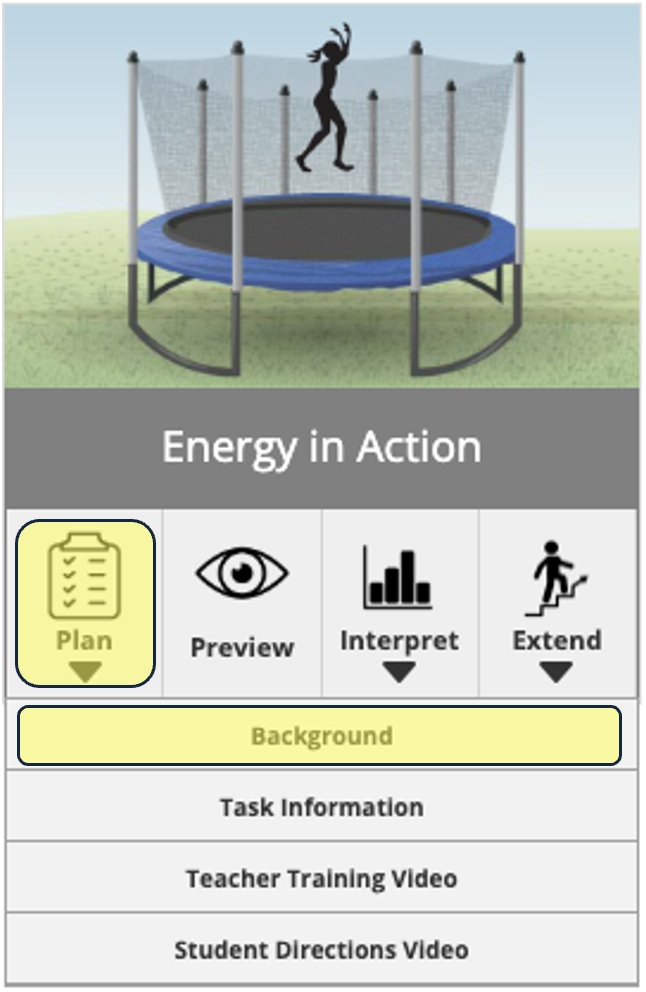
Each ONPAR task has a “Background” document that describes each dimension targeted in the task. Click the “Plan” drop-down menu to read the “Background” document for detail about which standards are in the task and on which screens. It also contains the learning progressions so you can see the standard at both the 5th and 8th grade level and target your instruction accordingly.
Put This Into Practice
After administering “Energy in Action,” your report might show that some students or classes need more focused support with specfic dimensions. Here are a few things you might try:
CCC: Energy & Matter The focus of this CCC is that energy may take different forms and the transfer of energy can be tracked as it flows through a system. “Energy in Action” has fairly complex systems, so it might be helpful to simplify the model using this Pendulum Energy Simulation with only kinetic, potential, and total energy. Play and pause to compare energy at different times; discuss how the total energy bar stays the same height with changing proportions of kinetic and potential energy. This and other activities are linked in the “Resources” tab of the Teacher Guide.
SEP: Analyzing & Interpreting Data This SEP asks students to analyze and interpret graphical displays of data to identify linear and nonlinear relationships. Create a gallery walk to practice interpretation using simple graphs you’ve created or printed. Students can start by describing relative relationships with words like “most,” “half,” “much less” or “none.” As their skills grow, they might describe how one element increases and another decreases over time. You might also collaborate with your math colleagues to help students use slope to identify and describe linear relationships in the data.
DCI: Definitions of Energy (PS3.A) and Energy Transfer (PS3.B) In order to explain how energy changes in a system using graphs, students need to understand the definitions of different types of energy (PS3.A). A word wall is a helpful tool to support student vocabulary development. Many ONPAR tasks are accompanied by visual vocabulary cards you can print and post in the classroom. For more support teaching vocabulary, read our Academic Language resource. Energy transfer (PS3.B) is closely intertwined with the CCC. Consider using the Pendulum Energy Simulation to re-teach concepts around this DCI.
Teacher Tip
How can ONPAR help me and my students?
Tempest, an 8th grade teacher in Lousiana, uses ONPAR to monitor student learning and address gaps in her curriculum.
“ONPAR provided interactive online tools that supported both experiments and checks for understanding. These digital science simulations allowed students to explore and maniuplate concepts virtually, even when a physical lab was unavailable
“This resource helped support both my students and myself in class because it included built-in checks for understanding. ONPAR also made it easy to identify where students were struggling and provided quick, meaningful feedback to guide instruction.
“Overall, ONPAR made science lessons more engaging, efficient, and effective for both the teacher and students.”
Do you want to share your experience with ONPAR? Reply to this email with a short explanation of a way you’re leveraging ONPAR in your classroom to be included in a future newsletter.
Updates
ONPAR Paper Tasks: We have updated the paper task answer keys to include more guidance for the SEPs & CCCs in each task. We also updated many tasks — such as “Cells,” “Earthquake Damage,” “Food Energy,” “Food Pathways,” “Fossil Record” and “Ocean Circulation” — and released a new engineering task about endothermic reactions in ice packs. If you’re using any of these, we’d love to hear how they are working in your classroom! Just reply to this email to share your feedback.
ONPAR Reports: We have updated reports for students and teachers in more than half of our units, and the remaining units will be released throughout the year. Read your classroom reports in the “Updated Report v2” column when available, or use the “v1” report when you would prefer the original view.
NSTA: Will you be at the NSTA National Conference in Minneapolis this month? Come to our session Friday, November 14 at 8:00am in room L100 G to learn more about ONPAR, rubrics, and cultures of assessment for learning.
Support for this project comes from the U.S. Department of Education, Education Innovation and Research (EIR) Grant Number S411C220116, Laura Wright, Principal Investigator, Linda Malkin, Co-PI.