Formative Assessment Culture
ONPAR Community NGSS Brief – Actionable Assessment for NGSS Classrooms
Why build a culture of formative assessment?
When students hear the word assessment they may think “testing,” “grades” or “high-stakes.” The purpose of formative assessment is as assessment for learning, rather than assessment of learning. Students do not automatically understand this process and must learn how to take and use feedback. Building this communal understanding necessitates a supportive classroom culture that allows students to be honest with admitting and learning from their mistakes and to trust they can share their thinking with their peers without being ridiculed.
Formative assessment is a process in which assessment-elicited evidence is used by teachers to adjust their ungoing instructional activities, or by students to adjust the ways they are trying to learn something. In contrast to its summative sibling, formative assessment has a powerful improvement orientation. (Popham, 2009)
Challenges
Students may be unfamiliar with a growth mindset and embarrassed to share their ideas if they cannot articulate them clearly with academic language. Research shows that students may not appreciate that feedback should be used to revise and improve their explanations. Many shy away from disagreeing with or correcting their peers because they do not want to hurt someone’s feelings. Some lack the emotional regulation to accept suggestions for improvement.
Successes
Developing a culture of assessment for learning happens over time. Many routines you already use can support this culture, such as:
- Develop classroom norms that build respectful, equitable, community-oriented learning
- Encourage students to use their own words as they build conceptual understanding
- Incorporate group work into formative assessments so students learn to support one another
- Provide feedback scaffolds like sentence starters and rubrics
- Model how to give and receive feedback
References
Carless, D., & Boud, D. (2018). The Development of Student Feedback Literacy: Enabling Uptake of Feedback. Assessment & Evaluation in Higher Education, 43(8), 1315–25.
Furtak, E.M. (2023). Formative Assessment for 3D Science Learning: Supporting Ambitious and Equitable Instruction. Teachers College Press.
Webb, M., & Jones, J. (2009). Exploring Tensions in Developing Assessment for Learning. Assessment in Education: Principles, Policy & Practice, 16(2), 165–84.
Look Inside: Handwarmers
How can I build a formative culture with ONPAR?
The “Handwarmers” paper task is a rich place to consider how ONPAR helps build — and fits within — your classroom culture of formative assessment. This video highlights ways to set up and debrief the task.
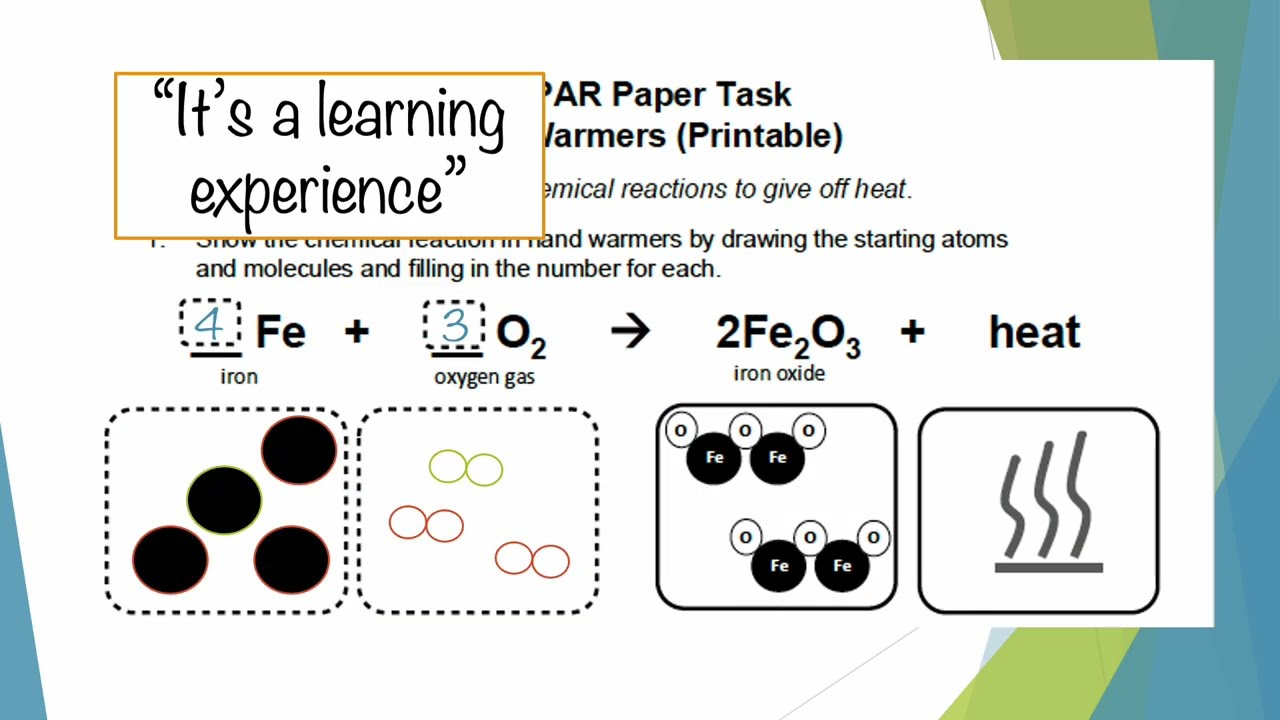
What prompts can help students debrief this task?
Classroom discussion can help students support one another through challenging tasks, but you might need scaffolds for whole-group discussion. The STEM Teaching Tools “Talk Resource” cards can help you build student capacity over time. For this task, the “Listening Carefully to One Another” or “Thinking With Each Other” card could help students deepen their learning by hearing from others, extending their thinking, and feeling that their ideas are respected. Have students practice agreeing, disagreeing, or adding on with some of these prompts:
- Do you agree/disagree? (And why?)
- Are you saying the same thing as Jeyla or something different, and if it’s different, how is it different?
- What do people think about what Vannia said?
- Does anyone want to respond to that idea?
- Who can add onto the idea that Jamal is building?
- Can anyone take that suggestion and push it a little further?
- Who thinks they can explain in their own words why Simon came up with that answer?
Put This Into Practice
How can I support small group discussions?
Small group discussion might feel safer as students build honesty and trust with their peers. Formative assessments with more than one correct answer, like page 2 of the “Handwamers” paper task, can generate genuine debate between students. Students can discuss their thinking, share different pieces of a complete model, and start to move away from a “one right answer” framework. Try supporting small group work with the “Evaluate and Compare” prompts from the STEM Teaching Tools “Constructive Conversation” cards, such as:
- How does the evidence for your argument compare to mine?
- How is that evidence stronger than this evidence?
- I think we should use the criteria of _____ because _____ …
- _____ is strong evidence because …
- Even though it seems valid that _____ , I disagree because …
Teacher Tip
Can ONPAR be used to build a formative assessment culture?
Vanessa, an 8th grade teacher in Louisiana, builds a culture of assessment for learning with ONPAR. She writes about the benefits of sustained use over the year:
“I am excited about getting to use ONPAR this year. The platform allows students to practice productive struggle while giving quality student data to make personalized and informed decisions on instruction. The data allowed me to facilitate discussions and remediate with students to help deepen understanding. As the year progressed, my students were asking deeper questions and using more science vocabulary when asking a question. The improvement in collaborative thinking and problem-solving skills was amazing to watch. I found that my students were taking more ownership of their work and were more intrinsically motivated on other assignments.
Do you want to share your experience with ONPAR? Reply to this email with a short explanation of a way you’re leveraging ONPAR in your classroom to be included in a future newsletter.
Updates
NSTA Minneapolis: ONPAR is presenting at the NSTA National Conference in Minneapolis! Join us Friday, November 14th at 8am to learn more about formative assessment culture and ONPAR rubrics.
ONPAR Updates: As you log into ONPAR for the new school year, you should be seeing a few updates. ONPAR now has a built-in translation toolbar. If you use digital books for students on the Activate portal, it will also be easier for you to assign ONPAR tasks to your students. Reach out to Activate Learning or reply to this email for support using either of these tools.
Support for this project comes from the U.S. Department of Education, Education Innovation and Research (EIR) Grant Number S411C220116, Laura Wright, Principal Investigator, Linda Malkin, Co-PI.